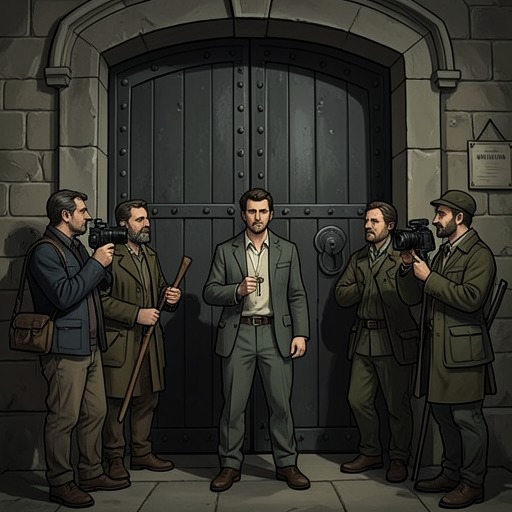
60 Minutes investigation of Walter McMillian’s case
Just MercyThe 60 Minutes investigation of Walter McMillian’s case brought evidence challenging his conviction to a national audience and disrupted a local narrative that had portrayed him as dangerous and unquestionably guilty. Bryan Stevenson, initially wary of publicity that could harm a client or a pending case, ultimately decided that the public needed a fuller account of the evidence. The broadcast provoked official and media backlash, but it also sharpened doubts within the community and preceded a consequential shift in the district attorney’s handling of the case.
Why the Case Went Public
Stevenson’s decision came amid competing risks. He feared that even sympathetic media coverage of a death-penalty case could trigger local hostility, worsen conditions for a client, or help accelerate an execution. Walter’s case carried an additional danger: if a new trial were ordered, the extensive prejudicial coverage already published might make a fair trial difficult. Yet local papers had repeatedly presented the prosecution’s claims as fact, describing McMillian as a drug kingpin, sexual predator, and gang leader, and emphasizing security measures at court as signs of his supposed danger. At a hearing, the defense had presented evidence that McMillian had nothing to do with the murder of Vickie Pittman, but local coverage continued to use that case to reinforce suspicion.
The team also understood that attention from outside the region could be treated as an attack on local institutions. The New York Times v. Sullivan decision had strengthened protections for reporting on civil-rights activism, but Stevenson expected national coverage of McMillian’s case to intensify Southern hostility toward the press and feared it would not help the appeal. Even so, he concluded that allowing the prosecution’s account to dominate carried its own costs: the community lacked a fair picture of the case, and McMillian’s possible release or retrial could unfold under a public image built almost entirely by his opponents.
Reporting in Monroeville
Stevenson had spoken at Yale Law School earlier that year, where a producer from 60 Minutes heard him and later contacted him. That summer, after the defense filed its appeal in the Court of Criminal Appeals, veteran reporter Ed Bradley and producer David Gelber traveled from New York City to Monroeville. They arrived on a July day when the temperature reached 100 degrees and interviewed people whose testimony or accounts had figured in the defense hearing: McMillian, Ralph Myers, Karen Kelly, Darnell Houston, Clay Kast, Jimmy Williams, McMillian’s family, and Woodrow Ikner. They also confronted Bill Hooks at his workplace and conducted an extensive interview with Tommy Chapman.
Bradley’s presence quickly became a local story in its own right. The Monroe Journal urged readers to distrust visiting reporters, portraying out-of-town coverage as superficial, scornful, and sometimes inaccurate. Before the program aired, a local report said Chapman believed the CBS researchers had formed their conclusions before arriving. Chapman also circulated an arrest-era photograph of McMillian, with long hair and a beard, as an image of the supposedly authentic suspect. McMillian looked different in the prison interview because Alabama prisoners were required to remain clean-shaven; the contrast allowed local commentary to cast the televised interview as a misleading presentation rather than consider the evidence behind it.
Broadcast and Backlash
When the segment aired months later, local officials and newspapers moved quickly to discredit it. The Mobile Press Register condemned the television account, and local writers argued that renewed attention would increase the strain on Ronda Morrison’s parents by leading people to think McMillian was innocent. These attacks were not separate from the earlier local coverage: the same outlets that had largely repeated the prosecution’s theory now criticized a report that exposed how one-sided that coverage had been.
Chapman’s televised position was one of certainty. In the interview, he rejected the suggestion that racial bias had shaped the prosecution, insisted McMillian was guilty and should be executed, and expressed contempt for the defense lawyers and those who questioned the jury’s verdict. The public confidence contrasted with what Chapman was beginning to think privately. The hearing had exposed serious weaknesses in the evidence, and he could no longer ignore the possibility that the conviction would be overturned. As the public defender of the case, he had also placed his credibility behind investigators whose work was now under scrutiny.
Effects on the Community and the Case
The broadcast reached viewers who already knew 60 Minutes and generally trusted it. Despite the local campaign against the program, it gave the community a concise account of the defense evidence and created questions about McMillian’s guilt. Some influential community leaders worried that the case made Monroeville appear backward and possibly racist, damaging the town’s image and its efforts to attract business. Business leaders began asking Chapman and law-enforcement officials pointed questions about the prosecution.
For many Black residents, the program made public what had circulated in whispers for years. McMillian’s wrongful conviction had so affected the Black community that people followed court developments closely and called the defense team for updates or clarification. Seeing the evidence presented in court laid out on national television offered many a measure of relief. The report therefore functioned not simply as outside commentary: it carried a suppressed local account into a shared public space, where viewers could compare it with the established accusations.
After the hearing and the growing attention to the case, Chapman brought Sheriff Tate, Woodrow Ikner, and Benson together and asked them to explain the contradictory evidence. Their answers did not satisfy him. He then formally requested that the Alabama Bureau of Investigation conduct another investigation into the murder to confirm McMillian’s guilt. The broadcast did not itself resolve the case, and it intensified resistance from local officials and media. But by helping make the evidence and its contradictions harder to ignore, it contributed to pressure for a new examination of the prosecution’s case.